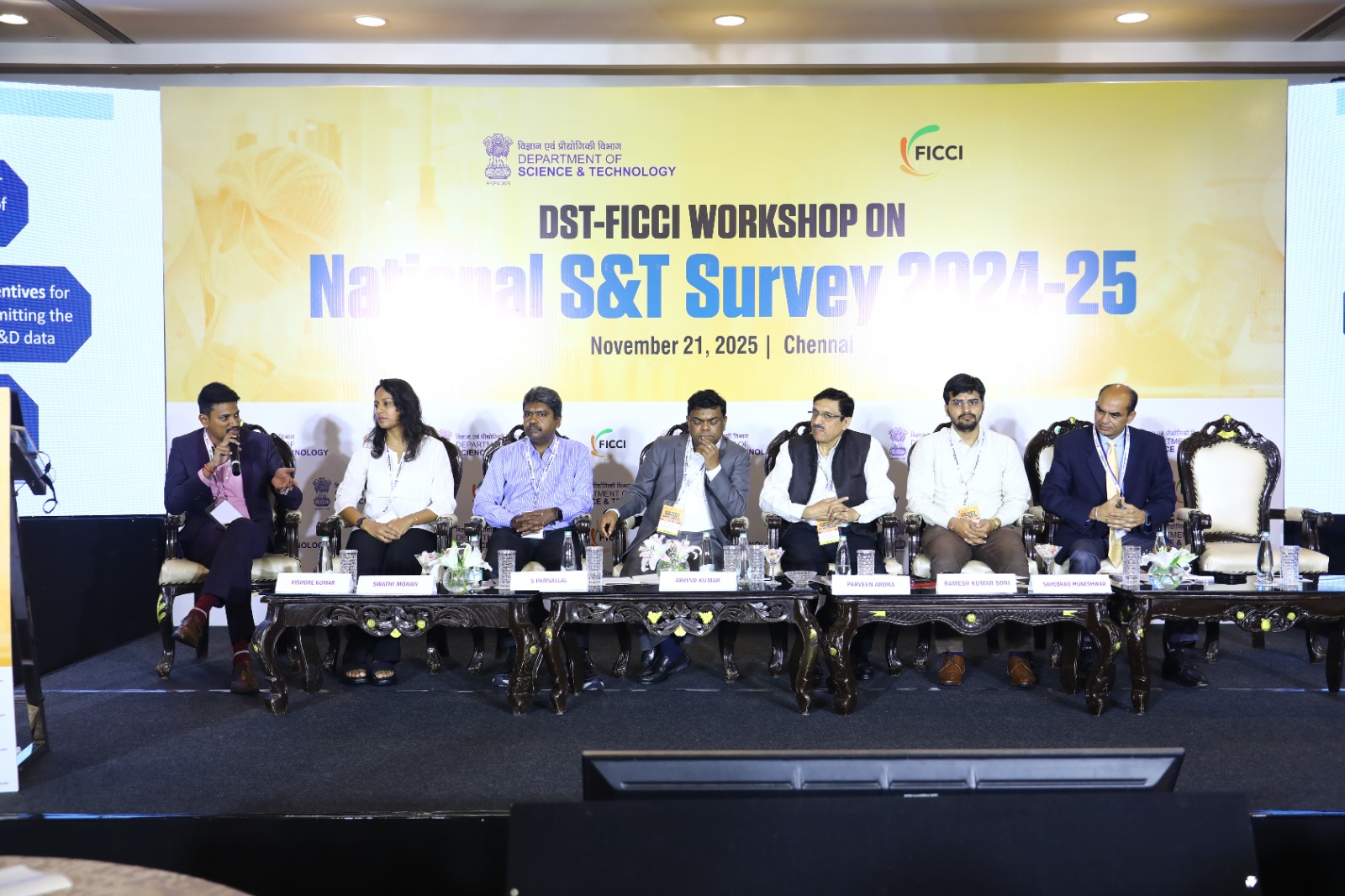
Chennai, India, November 21, 2025: The Department of Science and Technology (DST), Government of India, in partnership with the Federation of Indian Chambers of Commerce and Industry (FICCI), convened a high-level workshop on 21st November 2025 at Taj Connemara, Chennai, to deliberate on the National Survey on Resources Dedicated to Scientific and Technological (S&T) Activities for 2024–25. The survey is a key initiative to assess India’s R&D investment, S&T manpower, and innovation landscape that is crucial for shaping future research and innovation policies. It also contributes to international indices such as the Global Innovation Index and the SDG Global Indicator Framework.
The workshop was graced by the presence of senior representatives and policy makers from the government of India, industry representatives, experts and members from the academia including Dr. Arvind Kumar, Advisor & Head, NSTMIS, Department of Science & Technology (DST), Government of India and Dr. Parveen Arora, Former Head, NSTMIS, DST, Mr. Bhupesh Nagarajan, Co-Chairman, FICCI Tamil Nadu State Council and CMD, Indira Group of Companies, Mr. Ramesh Kumar Soni, Co-Founder & CEO, Vayujal Technologies Pvt. Ltd., Dr. S. Parivallal, Chief Scientist & Advisor, CSIR-SERC, Mr. Kishore Kumar, CEO, AIC Anna Incubator, Dr. Ms. Swathi Mohan, Co-Founder, Ionixx Technologies and Dr. Sahebrao Muneshwar, Associate Professor, Department of Aeronautical Engineering, Hindustan Institute of Technology and Science. The discussions aimed at underscoring the critical role of reliable and comprehensive data, especially from the private sector and in strengthening India’s science, technology, and innovation ecosystem, and fostering a more collaborative and data-driven framework to support effective S&T policy planning and national development.
Welcoming the gathering, Mr. Bhupesh Nagarajan, Co-Chairman, FICCI Tamil Nadu State Council and CMD, Indira Group of Companies, said, “Industry sensitization is crucial today, as India needs greater innovation in technology, startups, and research to meet the needs of our large and growing population. With rapid advancements in science, particularly in AI, ML, biotechnology, and pharmaceuticals, we must strengthen collaboration between academia, the research community, and industry. One of the key challenges I observe in India is the lack of seamless synchronization among these three pillars. Over the past decade, the Government of India’s S&T initiatives, schemes, and grants have been highly encouraging, motivating startups and industries to collaborate more closely. This clearly reflects the government’s commitment to promoting innovation and accelerating lab-to-market initiatives. I appreciate FICCI’s continued efforts in this direction, as India must advance on the right path with competent scientists and researchers leading our innovation journey. Tamil Nadu has emerged as one of the most dynamic centres for research and development, supported by institutions such as IIT Madras, Anna University, TICEL Park, and several initiatives by both the Government of India and the Tamil Nadu Government. Initiatives like this workshop on the National Survey on S&T is extremely important, not only for the research community but also for the general public. It helps us understand how much India is investing in research through DST and highlights the significance of industry participation. I strongly encourage industry members to actively take part in this survey. Your inputs will directly influence India’s national R&D planning, resource allocation, and long-term innovation strategies. By contributing, you are not merely filling a questionnaire, but are helping shape the nation’s innovation ecosystem. Achieving Viksit Bharat 2047 will not be possible without strong progress in research, innovation, and technology development. I sincerely appreciate the DST team for organizing a series of such workshops across the country, as they will truly be an eye-opener. With the continued support of DST, India can grow stronger, compete globally, and stand on par with Western economies as well as our counterparts in China.”

Dr. Arvind Kumar, Advisor and Head of the National Science, Technology & Management Information System (NSTMIS) at DST, in his address, urged industrial groups to actively contribute data, emphasizing that higher response rates and greater data accuracy are crucial for the survey’s effectiveness. He highlighted several government initiatives designed to strengthen private-sector innovation, including ₹ 1 lakh crore Research, Development & Innovation (RDI) Fund, which aims to provide long-term concessional financing for companies and startups in priority sectors such as energy transition, AI, robotics, quantum , bio-manufacturing, medical devices, and digital agriculture. The fund is expected to reduce risks associated with early-stage investments and significantly increase corporate contributions to GERD.
“While India’s Gross Expenditure on R&D investment in absolute terms has risen consistently—more than doubling over the years—the investment of industry in the R&D has historically remained low. Many industries are investing but not reporting their contributions to the government. This share must rise from the current 40% toward the global benchmark of 70%. In advanced economies, the corporate sector contributes nearly 70–75% of gross R&D expenditures, whereas in India it accounts for only about 36.5%. India’s overall R&D investment stands at around 0.64% of GDP. Bridging this gap is essential for achieving the nation’s innovation ambitions,” said Dr. Kumar.
Dr. Parveen Arora, Former Adviser & Head, NSTMIS, Department of Science & Technology (DST), Government of India, said, “While R&D and innovation are vital, accurate and timely reporting is even more important. Active participation from stakeholders is essential, as the data collected feeds directly into national and global policy frameworks, supporting evidence-based decision-making and ensuring a true representation of India’s innovation capabilities. Sensitizing stakeholders about the importance and benefits of the DST survey and building trust, engagement, and adequate handholding—are key to strengthening this ecosystem.”
Importance of the Survey:
Industry participants were reminded of the benefits of joining the survey, including access to sectoral benchmarking data, visibility in national science and innovation discussions, and alignment with future-oriented policies.
The National Science and Technology Management Information System (NSTMIS), Department of Science and Technology (DST), Government of India, has been conducting periodically national surveys to collect data on resources devoted to S&T activities (mainly R&D) in the country. Based on survey data, a number of S&T reports are published, providing vital information on national R&D indicators which serve as evidence-based for S&T assessment and policy formulation.
The national S&T survey 2024-25 aims at capturing the current R&D landscape by collecting information from around 8000 R&D organizations viz., public sector, private sector, MNCs, higher education, SIROs and NGOs spread across the country. A structured questionnaire based on international standardization of S&T resources has been designed seeking information on various aspects such as General Information, Expenditure on S&T (R&D) activities, R&D Manpower.
The workshop concluded with consensus that enhancing private sector participation and ensuring data quality in the National S&T Survey are central to shaping evidence-driven policies, spurring innovation, and realizing India’s long-term development aspirations.